
What Does Success Look Like Beyond Grades?
4 November 2026
Success goes beyond academic results. Find out how schools, parents and teachers can help children develop their strengths, explore different education pathways and prepare for the future.
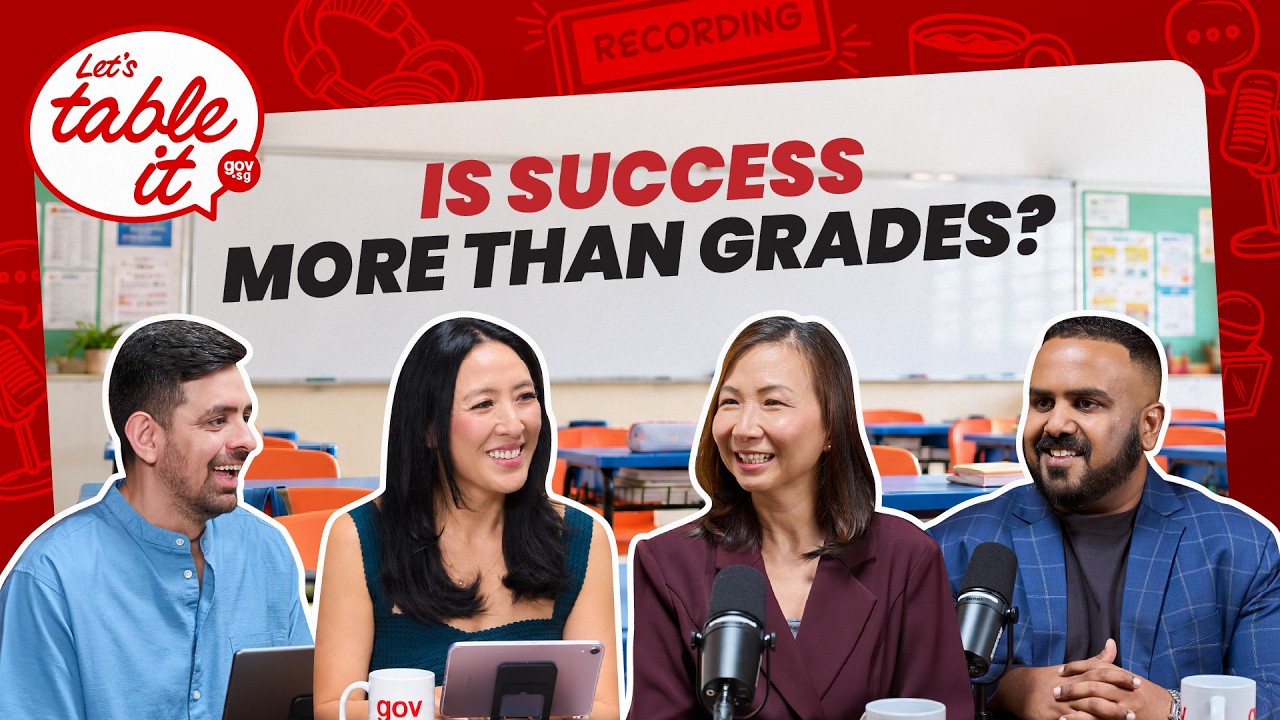
In Episode 4 of gov.sg's Let's Table It, Liew Wei Li, Director-General of Education at the Ministry of Education (opens in new tab) (MOE), and Prab Nathan, a former teacher and father of two, discussed what success means for our children, the pressures facing parents and students, and how we can rethink success with our children, so every child can find their own path.
Is there a “safer” path to success?
Success should reflect each child's strengths, interests and growth, rather than academic achievements alone.
Ms Liew noted that every child is different, with their own personality, interests and capabilities. What matters is whether children are thriving, developing their potential and learning to contribute in their own ways.
Beyond academic knowledge, schools also seek to develop good character and social-emotional competencies, such as self-awareness, self-management, working with others and responsible decision-making.
Prab shared how his own understanding of success had changed. Growing up, he associated success with good grades and entering prestigious courses. As a parent, he now focuses on encouraging his children to do their best in whatever they pursue.
Is every school truly a good school?
MOE provides schools with the same curriculum, similarly trained teachers, resources and quality infrastructure, while individual schools have their own cultures and programmes.
Ms Liew explained that schools share common foundations but differ in their heritage, traditions and learning experiences. For example, schools offer Applied Learning Programmes in different areas, allowing students to explore their interests and strengths.
Schools also provide learning support for students with different abilities, including those who learn at a faster pace. Instead of relying solely on a school's reputation, she encouraged parents to attend school open houses and speak with families whose children attend the schools.
Prab shared that school culture, including the experiences of teachers and students, was an important consideration when choosing a primary school for his daughter. He also shared his thought process on how his choice was based on several factors that may be contrary to the “norm”.
Do PSLE results determine a child's future?
The Primary School Leaving Examination (PSLE) provides an indication of a child's learning at a particular point in time, helping students and educators identify strengths and areas for improvement.
Ms Liew explained that examinations help educators and students understand learning progress. She acknowledged that parents and children respond differently to the PSLE scoring system. Some may experience less stress, while others continue to feel pressure, particularly when focused on entering a specific school.
Singapore's education system also provides different pathways for students to develop their strengths. Ms Liew shared that under the Full Subject-Based Banding, students can study subjects at different levels based on their PSLE subject Achievement Level (AL) scores and subsequently take subjects at more demanding levels as they progress.
Students are encouraged to consider their strengths, learning preferences and aspirations when choosing a pathway, rather than simply following their friends.
How can children pursue their talents beyond academics?
Children can develop their interests and talents through different school programmes and admission pathways, including Direct School Admission (opens in new tab) (DSA). The DSA allows students with strong abilities in particular areas to seek admission to schools offering relevant talent development programmes.
Specialised schools, such as the School of the Arts and Singapore Sports School, also provide opportunities for students who wish to devote more time to developing particular strengths. However, Ms Liew emphasised that DSA is not intended for everyone, and the PSLE remains the main admission route for most students.
Parents can support their children by understanding their interests, visiting schools together and involving them in decisions. This helps children gradually develop independence and learn to make responsible choices.
How should children learn in the age of artificial intelligence?
Artificial intelligence (AI) can support learning, but children must first develop the knowledge and thinking skills needed to use it appropriately.
AI can be used as a learning tool to explain concepts and guide students through problems. However, simply using AI to obtain answers can prevent children from developing their own understanding. Ms Liew cautioned parents against using AI to complete their children's homework, emphasising that working through difficulties is an important part of learning.
Students also need fundamental knowledge, critical thinking and the ability to evaluate whether AI-generated information is correct. AI can support teachers in their work, but it cannot replace their role in motivating students and supporting their overall development.
How can parents and teachers help children succeed?
Parents and teachers can help children thrive by working together, supporting their independence and guiding them through setbacks.
Ms Liew described parents as their children's first teachers, particularly in modelling values, character and ways of handling life's challenges. She emphasised that adults should not simply remove difficulties for children. Instead, they can help children process their emotions, understand what went wrong and build the confidence to try again.
Teachers play a complementary role by guiding students through learning challenges and helping them develop beyond academics. Both Ms Liew and Prab stressed the importance of parents and teachers working together, sharing observations about children at home and in school, and supporting their development.
Ultimately, parents should see success as a journey rather than a fixed destination. Children should have opportunities to understand their strengths, explore their interests and discover the paths that are right for them.
This article is based on Episode 4 of Let's Table It, titled Is Success More Than Grades?. Figures, measures and proposals reflect the information shared in the podcast.
Watch or listen:
YouTube (opens in new tab) | Spotify (opens in new tab) | Apple Podcasts (opens in new tab)